
How Tall Should a Patio Pergola Be? Typical and Special Considerations
October 28, 2025
The evening sun casts a warm glow across the patio. A family gathers beneath a sleek aluminum pergola—soft music plays, dinner is served, and the open yet sheltered space feels just right. The roof offers shade without blocking the breeze, the lights hang at a comfortable height, and every proportion seems effortlessly balanced. It’s not by accident—it’s the result of choosing the right pergola height.
The height of a patio pergola directly affects the shade, airflow, visual balance, and overall usability of your outdoor space. Choosing the right height can make your pergola feel inviting and spacious, while a miscalculated one can make it feel cramped or out of proportion with your home’s architecture.
Understand the Standard Pergola Height Basics
1.How Tall Should a Patio Pergola Be Typically?
Most outdoor patio with pergolas fall within a standard height range of 8 to 12 feet (about 2.4 m to 3.7 m). This range offers a balanced mix of comfort, functionality, and aesthetics.
- An 8-foot (≈ 2.4 m) height is often viewed as the minimum practical height. It provides enough headroom for most people without the structure feeling too cramped.
- More commonly, homeowners pick 9 to 10 feet (≈ 2.7 to 3 m) as a “sweet spot” for their patio pergola. That’s because this diameter range is tall enough for comfort, airflow, and lighting clearance, yet not so tall that the pergola feels detached from the landscape.
- For larger outdoor areas or more dramatic design statements, heights of 11 to 12 feet (or taller) can be appropriate, especially when the pergola covers a big span and must maintain visual balance.
2.Attached vs. Freestanding: How Attachment to a House Wall Influences Ideal Height?
The type of pergola, whether attached to the house or freestanding, also affects your choice of height.
- Attached (Wall-Mounted or Lean-To)
When attaching to a house, you must coordinate with existing building features, including windows, eaves, gutters, siding, and rooflines. You don’t want pergola beams or rafters to block a window view or interfere with gutters.
The attachment point (ledger) often constrains the height: many designs align the pergola top or beam line just below or slightly above the house’s eaves, so it feels like a natural extension.
Due to these constraints, attached pergolas in patio areas often fall on the lower end of the standard range (e.g., 8 to 10 feet) to maintain harmony with the existing architecture.
- Freestanding
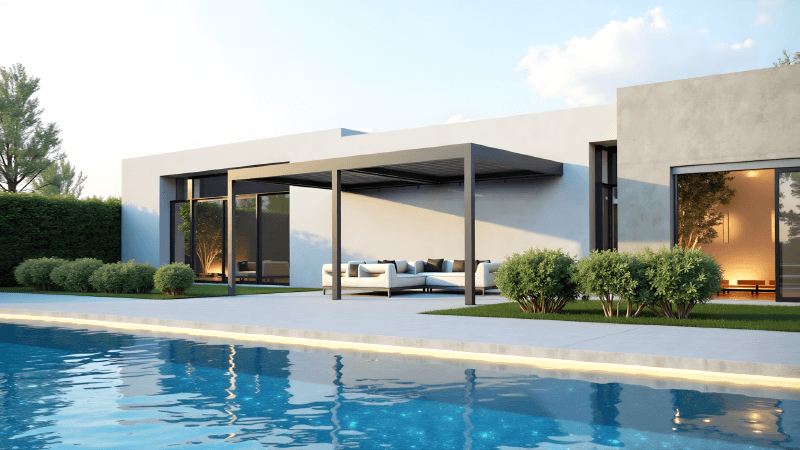
A freestanding pergola offers much more flexibility because it doesn’t need to align with an existing wall. You can choose a height that best balances visual scale, airflow, and usability. Because gutters or roof overhangs do not constrain you, you have more freedom to design the height you want and accommodate features like ceiling fans, pendants, taller drapery, or climbing plants. That said, going extremely tall without context may make the pergola feel disconnected from its surroundings or diminish its shade-effectiveness (depending on sun angles).
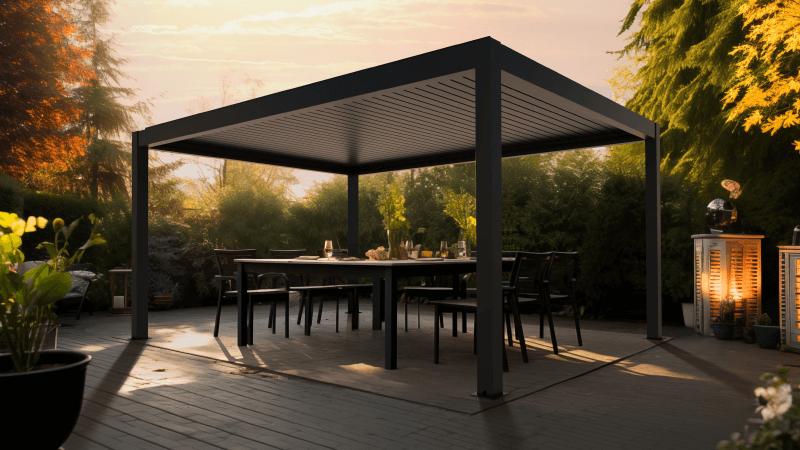
Here’s a chart to make it clearer to understand the differences between pergola in freestanding vs attaching:
| Type | Key Features | Design Considerations | Ideal Height Range |
| Attached Pergola | Connects directly to the house wall or roofline | Eaves, gutters, or windows often limit height. | Lower than
8–10 ft (≈ 2.4 –3 m) |
| Freestanding Pergola | Stands independently anywhere | More flexible in height and design; taller options improve airflow and visual openness. | 9–12 ft
(≈ 2.7–3.7 m) |
3.Roof Type: Flat vs. Pitched or Louvered Roofs
The type of roof you choose also determines how much extra height on the patio pergola or clearance space you’ll need to accommodate its structure.
| Roof Type | Why It Matters |
| Flat Roof | The simplest design; height clearance mainly depends on the desired headroom and lighting fixtures. |
| Pitched Roof | Sloped frames require extra elevation to maintain symmetry and proper water runoff. |
| Louvered Roof | Motorized blades and drainage systems need sufficient space for tilting and internal mechanics. |
Special Scenarios That Require Height Adjustments for Safety and Balance
4.Proportion to Patio Space
Don’t forget: When installing a patio pergola, consider how it will interact with the home’s surroundings, including eaves, outdoor lighting, nearby trees, and balcony edges. The goal is to leave enough room for both visual balance and functional clearance, so the structure doesn’t feel squeezed or obstructed. So, you’d better understand the exact height of your patio pergola.
| Patio Environment | Design Rationale |
| Under house eaves or roof extension | Prevents interference with rainwater flow and avoids heat buildup from roof reflection. |
| Next to upper-level windows or balconies | Ensures open sightlines and prevents the pergola from blocking ventilation or natural light. |
| In open patio areas (freestanding setup) | Allows for adequate air movement and safe clearance for lighting or motorized louvers. |
| Near trees or overhanging branches | Prevents leaves from accumulating on top, reducing maintenance and potential storm damage. |
Special Scenarios That Require Height Adjustments for Safety and Balance
In some situations, safety, ventilation, or architectural alignment demand customized height adjustments, which would be out of the standard we mentioned above.
1. Outdoor Kitchens or Fire Features
When you’re placing a grill, fire pit, fireplace, or other combustion-based amenities under or near the pergola, heat and smoke clearance become critical because of its rising nature. So, a too-low roof can trap heat, damage materials, or pose fire hazards.
| Feature | Recommended Vertical Clearance |
| Fire pit/burner | ~84 in (7 ft) from top of fire pit to underside of pergola ceiling (Taking ≤ ~200,000 BTU as an example) |
| General fire or grilling area | At least 10 ft total post height |
| Overhead clearances | Maintain at least 7 ft between the fire feature and the ceiling, fan, or light fixtures |
| Horizontal buffer | ≥ 3 ft radius free of combustibles |
2.Two-Story Homes
If your pergola is attached or located adjacent to a multi-story structure, its height must harmonize with upper windows, balconies, rooflines, and the overall facade.
Height alignment factors:
- Your patio pergola should generally not block second-story windows, HVAC vents, or balconies. Leave clear sightlines from upstairs rooms.
- The top of the pergola (or its beam/rail line) can be coordinated with architectural features—e.g., aligning with the bottom of balcony guardrails or windowsills.
- A pergola that is too low may feel disconnected from a tall home; one that is too high may dominate the view or create awkward shadow lines.
3. Sloped Terrain
When your patio or yard is on uneven ground or a slope, using uniform post lengths alone will result in a crooked pergola. To maintain a level roofline and pleasing visual continuity, adjustments are necessary.
- Vary post lengths: On the downhill side, use longer posts so the top of all post lines up level.
- Use stepped or tiered platforms: Build small retaining walls or steps beneath the pergola area to reduce grade change under the canopy.
- Maintain consistent roof height above the walking surface: Measure from the final finished patio/ground elevation to the underside of the rafters — not from raw soil.
A Smart Pergola for Patio: Greenawn’s TO-981
So, how tall should a patio pergola be? As mentioned above, a standard patio pergola is around 8-12 feet tall. Yet, there are some considerations to make some changes according to the specific patio design ideas.
Greenawn’s TO-981 is an aluminum pergola that is designed for professional suppliers and installers who need versatility, durability, and a premium look to satisfy different customer demands. It’s built for performance and flexibility—the height can be customized to suit varying installation environments and architectural styles, ensuring perfect integration in every project.
Here are more details below:
Multiple Installation Options: The TO-981 supports wall-mounted, freestanding, and wall-hanging setups and up to 5 different styles, making it adaptable for patios, rooftops, gardens, and other commercial outdoor spaces. This flexibility allows you to tailor solutions for different customer layouts.
Hollow Shuttle Louver System: Featuring a 120° swivel design, this system provides superior top shading and ventilation control for your outdoor patio with a pergola. Its 100% waterproof structure ensures all-weather reliability, helping customers seek comfort and convenience.
Hidden Drainage System: Engineered with sealed, built-in drainage channels, this patio pergola can effectively manage rainwater without exposing pipes or compromising design integrity. This hidden system enhances both durability and aesthetics—an advantage that appeals to discerning buyers.
Waterproof LED Lighting System: The integrated low-power LED lights create a refined ambiance for nighttime use. Fully waterproof and energy-efficient, they highlight the pergola’s craftsmanship while offering long-term reliability.
Want to explore tailored configurations and bring superior pergola solutions to your market? Contact Greenawn today!

Why You Should Install a Pergola in the Backyard?
blogDo Pergola Louvred Roofs Protect from Rain?
blogBest Motorized Louvred Pergola Systems for Commercial Projects
blog