
How Tall Should a Patio Pergola Be? Typical and Special Considerations
October 28, 2025
The evening sun casts a warm glow across the patio. A family gathers beneath a sleek aluminum pergola—soft music plays, dinner is served, and the open yet sheltered space feels just right. The roof offers shade without blocking the breeze, the lights hang at a comfortable height, and every proportion seems effortlessly balanced. It’s not by accident—it’s the result of choosing the right pergola height.
The height of a patio pergola directly affects the shade, airflow, visual balance, and overall usability of your outdoor space. Choosing the right height can make your pergola feel inviting and spacious, while a miscalculated one can make it feel cramped or out of proportion with your home’s architecture.
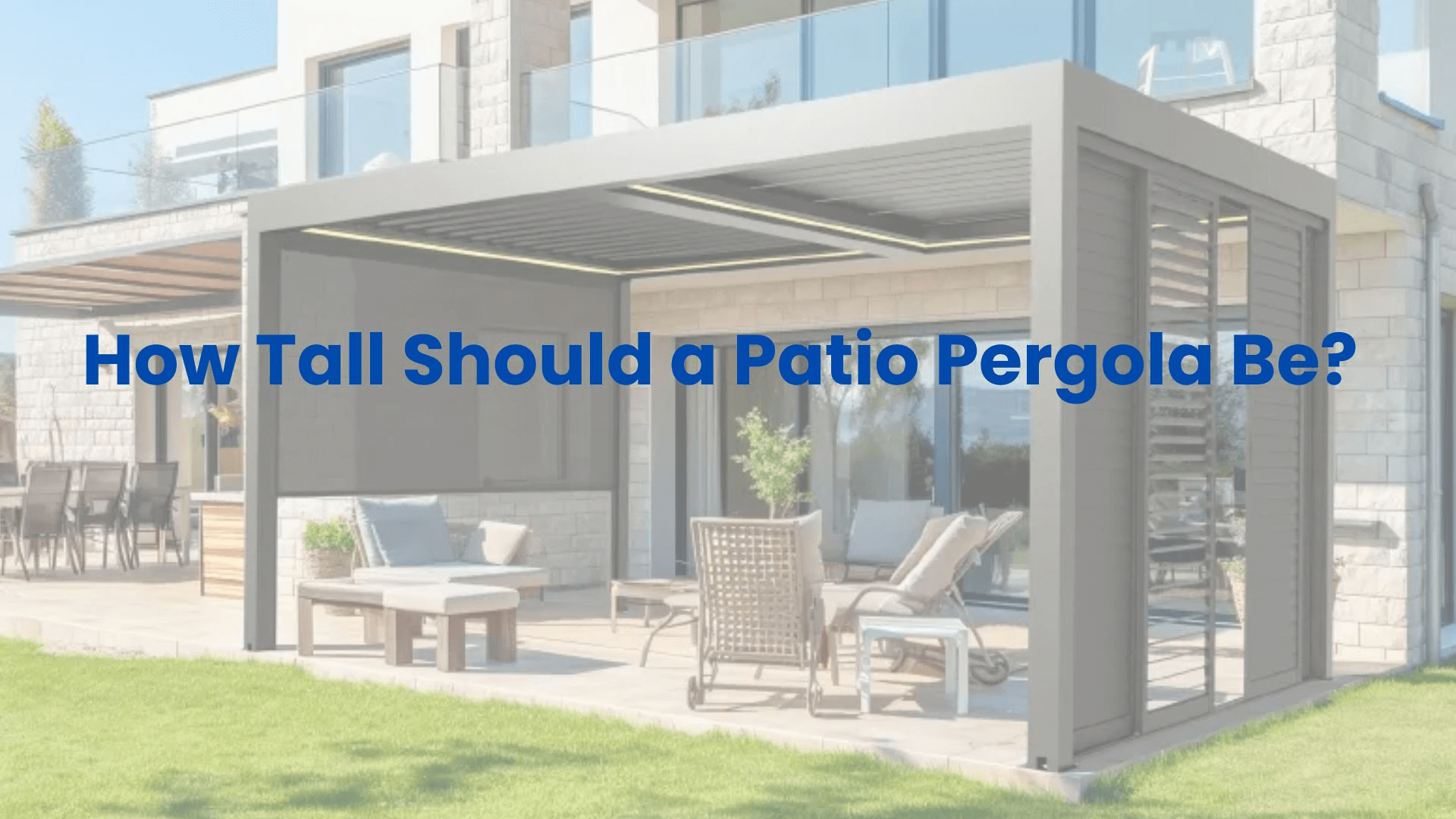
Understand the Standard Pergola Height Basics
1.How Tall Should a Patio Pergola Be Typically?
Most outdoor patio with pergolas fall within a standard height range of 8 to 12 feet (about 2.4 m to 3.7 m). This range offers a balanced mix of comfort, functionality, and aesthetics.
- An 8-foot (≈ 2.4 m) height is often viewed as the minimum practical height. It provides enough headroom for most people without the structure feeling too cramped.
- More commonly, homeowners pick 9 to 10 feet (≈ 2.7 to 3 m) as a “sweet spot” for their patio pergola. That’s because this diameter range is tall enough for comfort, airflow, and lighting clearance, yet not so tall that the pergola feels detached from the landscape.
- For larger outdoor areas or more dramatic design statements, heights of 11 to 12 feet (or taller) can be appropriate, especially when the pergola covers a big span and must maintain visual balance.
2.Attached vs. Freestanding: How Attachment to a House Wall Influences Ideal Height?
The type of pergola, whether attached to the house or freestanding, also affects your choice of height.
- Attached (Wall-Mounted or Lean-To)
When attaching to a house, you must coordinate with existing building features, including windows, eaves, gutters, siding, and rooflines. You don’t want pergola beams or rafters to block a window view or interfere with gutters.
The attachment point (ledger) often constrains the height: many designs align the pergola top or beam line just below or slightly above the house’s eaves, so it feels like a natural extension.
Due to these constraints, attached pergolas in patio areas often fall on the lower end of the standard range (e.g., 8 to 10 feet) to maintain harmony with the existing architecture.
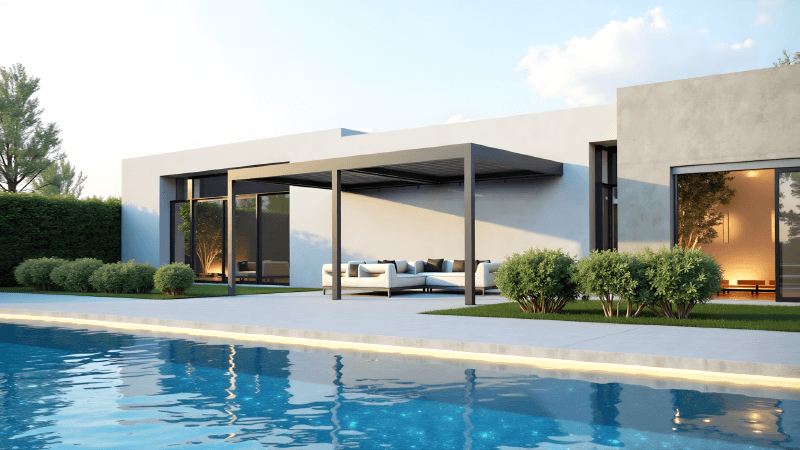
- Freestanding
A freestanding pergola offers much more flexibility because it doesn’t need to align with an existing wall. You can choose a height that best balances visual scale, airflow, and usability. Because gutters or roof overhangs do not constrain you, you have more freedom to design the height you want and accommodate features like ceiling fans, pendants, taller drapery, or climbing plants. That said, going extremely tall without context may make the pergola feel disconnected from its surroundings or diminish its shade-effectiveness (depending on sun angles).
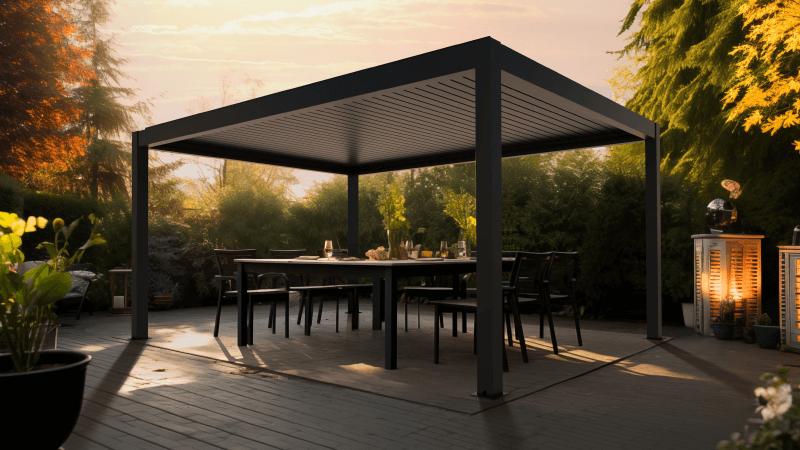
Here’s a chart to make it clearer to understand the differences between pergola in freestanding vs attaching:
| Type | Key Features | Design Considerations | Ideal Height Range |
| Attached Pergola | Connects directly to the house wall or roofline | Eaves, gutters, or windows often limit height. | Lower than
8–10 ft (≈ 2.4 –3 m) |
| Freestanding Pergola | Stands independently anywhere | More flexible in height and design; taller options improve airflow and visual openness. | 9–12 ft
(≈ 2.7–3.7 m) |
3.Roof Type: Flat vs. Pitched or Louvered Roofs
The type of roof you choose also determines how much extra height on the patio pergola or clearance space you’ll need to accommodate its structure.
| Roof Type | Why It Matters |
| Flat Roof | The simplest design; height clearance mainly depends on the desired headroom and lighting fixtures. |
| Pitched Roof | Sloped frames require extra elevation to maintain symmetry and proper water runoff. |
| Louvered Roof | Motorized blades and drainage systems need sufficient space for tilting and internal mechanics. |
Special Scenarios That Require Height Adjustments for Safety and Balance
4.Proportion to Patio Space
Don’t forget: When installing a patio pergola, consider how it will interact with the home’s surroundings, including eaves, outdoor lighting, nearby trees, and balcony edges. The goal is to leave enough room for both visual balance and functional clearance, so the structure doesn’t feel squeezed or obstructed. So, you’d better understand the exact height of your patio pergola.
| Patio Environment | Design Rationale |
| Under house eaves or roof extension | Prevents interference with rainwater flow and avoids heat buildup from roof reflection. |
| Next to upper-level windows or balconies | Ensures open sightlines and prevents the pergola from blocking ventilation or natural light. |
| In open patio areas (freestanding setup) | Allows for adequate air movement and safe clearance for lighting or motorized louvers. |
| Near trees or overhanging branches | Prevents leaves from accumulating on top, reducing maintenance and potential storm damage. |
Special Scenarios That Require Height Adjustments for Safety and Balance
In some situations, safety, ventilation, or architectural alignment demand customized height adjustments, which would be out of the standard we mentioned above.
1. Outdoor Kitchens or Fire Features
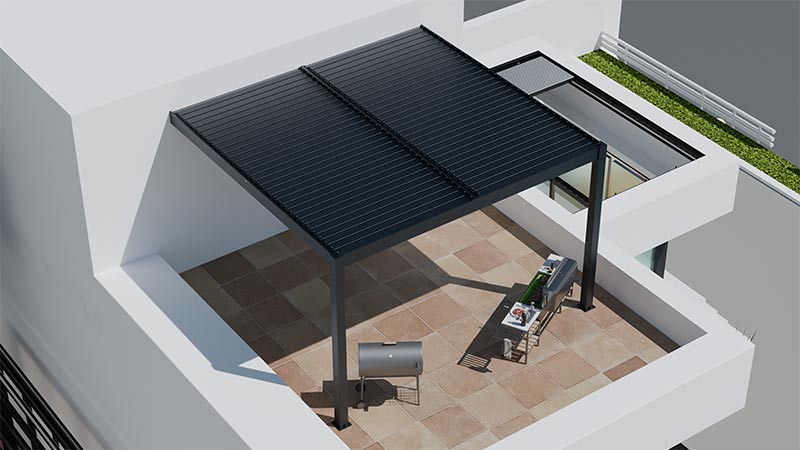
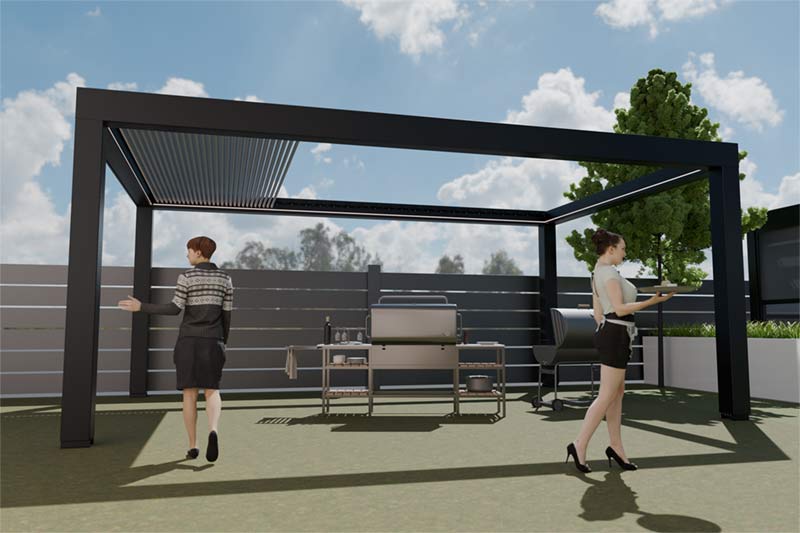
When you’re placing a grill, fire pit, fireplace, or other combustion-based amenities under or near the pergola, heat and smoke clearance become critical because of its rising nature. So, a too-low roof can trap heat, damage materials, or pose fire hazards.
| Feature | Recommended Vertical Clearance |
| Fire pit/burner | ~84 in (7 ft) from top of fire pit to underside of pergola ceiling (Taking ≤ ~200,000 BTU as an example) |
| General fire or grilling area | At least 10 ft total post height |
| Overhead clearances | Maintain at least 7 ft between the fire feature and the ceiling, fan, or light fixtures |
| Horizontal buffer | ≥ 3 ft radius free of combustibles |
2.Two-Story Homes
If your pergola is attached or located adjacent to a multi-story structure, its height must harmonize with upper windows, balconies, rooflines, and the overall facade.
Height alignment factors:
- Your patio pergola should generally not block second-story windows, HVAC vents, or balconies. Leave clear sightlines from upstairs rooms.
- The top of the pergola (or its beam/rail line) can be coordinated with architectural features—e.g., aligning with the bottom of balcony guardrails or windowsills.
- A pergola that is too low may feel disconnected from a tall home; one that is too high may dominate the view or create awkward shadow lines.
3. Sloped Terrain
When your patio or yard is on uneven ground or a slope, using uniform post lengths alone will result in a crooked pergola. To maintain a level roofline and pleasing visual continuity, adjustments are necessary.
- Vary post lengths: On the downhill side, use longer posts so the top of all post lines up level.
- Use stepped or tiered platforms: Build small retaining walls or steps beneath the pergola area to reduce grade change under the canopy.
- Maintain consistent roof height above the walking surface: Measure from the final finished patio/ground elevation to the underside of the rafters — not from raw soil.
A Smart Pergola for Patio: Greenawn’s TO-981
So, how tall should a patio pergola be? As mentioned above, a standard patio pergola is around 8-12 feet tall. Yet, there are some considerations to make some changes according to the specific patio design ideas.
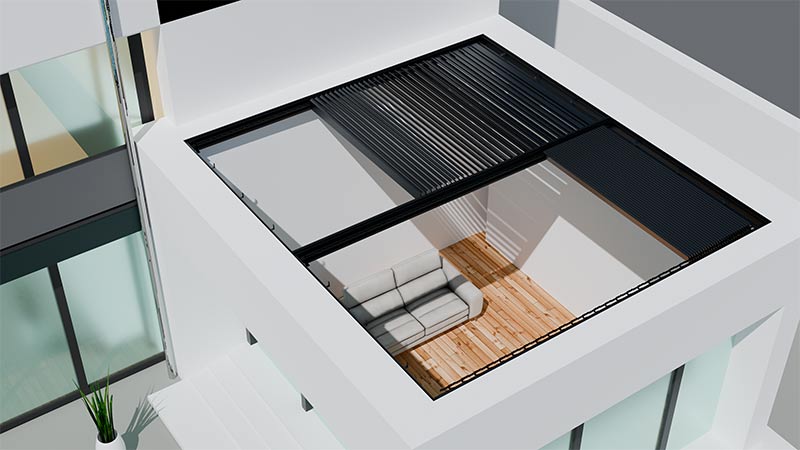
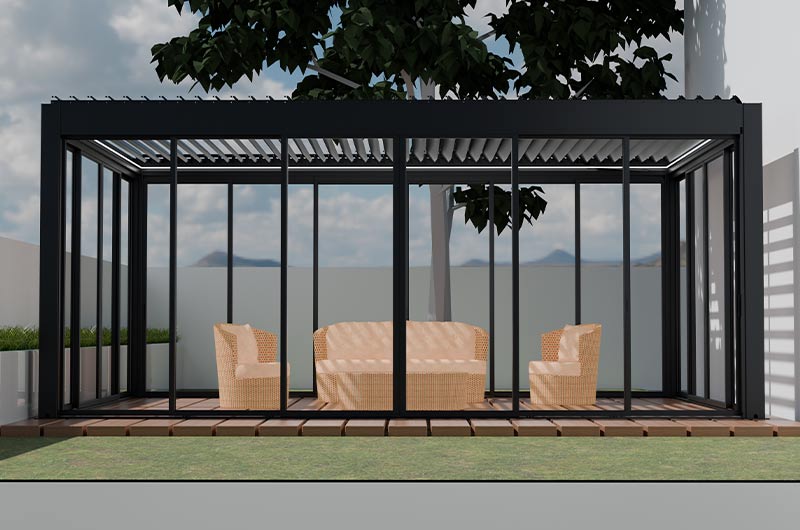
Greenawn’s TO-981 is an aluminum pergola that is designed for professional suppliers and installers who need versatility, durability, and a premium look to satisfy different customer demands. It’s built for performance and flexibility—the height can be customized to suit varying installation environments and architectural styles, ensuring perfect integration in every project.
Here are more details below:
Multiple Installation Options: The TO-981 supports wall-mounted, freestanding, and wall-hanging setups and up to 5 different styles, making it adaptable for patios, rooftops, gardens, and other commercial outdoor spaces. This flexibility allows you to tailor solutions for different customer layouts.
Hollow Shuttle Louver System: Featuring a 120° swivel design, this system provides superior top shading and ventilation control for your outdoor patio with a pergola. Its 100% waterproof structure ensures all-weather reliability, helping customers seek comfort and convenience.
Hidden Drainage System: Engineered with sealed, built-in drainage channels, this patio pergola can effectively manage rainwater without exposing pipes or compromising design integrity. This hidden system enhances both durability and aesthetics—an advantage that appeals to discerning buyers.
Waterproof LED Lighting System: The integrated low-power LED lights create a refined ambiance for nighttime use. Fully waterproof and energy-efficient, they highlight the pergola’s craftsmanship while offering long-term reliability.
Want to explore tailored configurations and bring superior pergola solutions to your market? Contact Greenawn today!
How to Choose the Right Aluminum Pergola Supplier: A Complete B2B Buyer’s Guide in 2026| Greenawn
blogChoosing the right aluminum pergola supplier can directly impact your business’s profitability, project success, and customer satisfaction.
Whether you are a distributor, contractor, importer, or outdoor living brand, the supplier you choose will influence product quality, delivery timelines, customization options, and long-term growth opportunities.
With hundreds of pergola manufacturers competing globally, buyers often face the same questions. Should you source locally or overseas? Are Chinese pergola suppliers reliable? How can you verify manufacturing capabilities before placing large orders?
This guide answers those questions and provides a practical framework for evaluating suppliers, comparing sourcing options, and making informed purchasing decisions in 2026.
What Should B2B Buyers Look for When Choosing an Aluminum Pergola Supplier?
Not all suppliers offer the same level of manufacturing expertise, engineering support, or production capacity.
The most successful buyers focus on long-term value rather than simply finding the lowest price.
Manufacturer or Trading Company: Why the Difference Matters
One of the first questions buyers should ask is whether they are dealing directly with a manufacturer or a trading company.
A genuine manufacturer controls production processes, quality inspections, and delivery schedules. This typically results in more consistent product quality and faster communication.
Working directly with a factory also provides greater flexibility when discussing custom dimensions, colors, accessories, and branding requirements.
In addition, after-sales support is often more responsive because technical teams are located within the same organization.
How Much Manufacturing Capacity Does a Pergola Supplier Need?
Production capacity becomes increasingly important as your business grows.
A supplier may perform well on small orders but struggle when demand increases.
Evaluate factors such as factory size, production equipment, workforce stability, and monthly output capacity.
Reliable pergola manufacturers should be capable of supporting multiple container shipments while maintaining consistent lead times during peak seasons.
For distributors and wholesalers, scalability is just as important as product quality.
What Certifications Should Pergola Manufacturers Have?
Certifications demonstrate a supplier’s commitment to quality and compliance.
Depending on your market, buyers may require:
These documents help reduce compliance risks and provide confidence when bidding on commercial projects.
Can the Supplier Support Long-Term Business Growth?
A strong supplier should function as a strategic partner rather than simply a product vendor.
Look for manufacturers with proven export experience, dedicated engineering teams, and stable production capabilities.
Suppliers that support business growth often provide product development assistance, marketing materials, technical documentation, and OEM or ODM services.
Why Are More Global Buyers Working with Chinese Pergola Suppliers?
Over the past decade, China has become one of the world’s leading manufacturing hubs for aluminum pergola systems.
Today, many international distributors and outdoor living brands rely on Chinese pergola suppliers for both standard and customized solutions.
Are Chinese Pergola Suppliers Really More Cost-Effective?
The answer is generally yes.
China benefits from a highly integrated aluminum manufacturing ecosystem.
Raw material suppliers, extrusion factories, powder coating facilities, motor suppliers, and hardware manufacturers are often located within the same industrial regions.
This supply chain efficiency helps reduce production costs without necessarily compromising quality.
As a result, buyers can often achieve better margins compared to sourcing from local suppliers.
How Do Chinese Pergola Manufacturers Compare with Local Suppliers?
The comparison depends on your priorities.
Chinese Pergola Supplier vs Local Supplier Comparison
Local suppliers may provide faster delivery and easier site visits.
However, Chinese suppliers often outperform in customization, manufacturing scale, and pricing competitiveness.
What Risks Should Buyers Consider When Sourcing from China?
While many Chinese pergola manufacturers are highly professional, buyers should still conduct due diligence.
Potential risks include inconsistent quality standards, limited engineering support, and communication challenges.
These risks can usually be minimized through proper supplier verification.
How to Verify a Reliable Chinese Pergola Supplier Before Ordering
Verification should include several steps.
Request factory videos and production footage. Verify unedited on-site footage to confirm the supplier’s real production capability and factory scale.
Review testing reports and certifications. Confirm all certificates are valid and compliant with your local market import standards.
Conduct third-party inspections whenever possible. Use professional third-party audits to avoid false supplier qualification information.
Request customer references from your target markets. Check local client feedback to verify the supplier’s service and product credibility.
Evaluate product samples before placing large orders. Test sample quality and performance to ensure it matches your bulk order standards.
Another effective method is meeting suppliers at international exhibitions. Trade shows provide opportunities to assess product quality, engineering capabilities, and communication professionalism face-to-face.
How Do Leading Louvered Pergola Manufacturers Ensure Product Quality and Compliance?
Quality and compliance are increasingly important in commercial projects.
The best louvered pergola manufacturers invest heavily in engineering, testing, and product development.
What Wind Load Ratings Are Required for Commercial Pergolas?
Wind resistance requirements vary by region.
Coastal markets and hurricane-prone areas typically require higher structural performance standards( ≥75–100mph).
Professional manufacturers conduct structural calculations and testing to verify product performance under different environmental conditions.
Buyers should always request wind load documentation before approving commercial projects.
How Important Is Waterproof Performance in a Louvered Pergola System?
Waterproof performance is one of the most common concerns among end users.
Modern louvered pergola systems rely on integrated drainage channels, sealing technology, and hidden gutter systems.
When properly designed, rainwater is efficiently collected and directed away from the structure.
Poor drainage design can lead to leaks, customer complaints, and warranty claims.
Which Aluminum Specifications Deliver Long-Term Durability?
Material quality directly affects product lifespan.
High-quality pergolas typically use premium-grade aluminum alloys such as 6063-T5, combined with durable powder coating systems.
Buyers should evaluate:
These factors become particularly important in coastal environments where salt exposure accelerates corrosion.
What Engineering Documents Should Buyers Request?
Professional pergola manufacturers should provide complete technical documentation.
Important documents include:
These resources support project planning, installation efficiency, and regulatory compliance.
OEM vs ODM Pergola Manufacturing: Which Option Is Better for Your Business?
Customization is becoming increasingly important in competitive markets.
Understanding the difference between OEM and ODM manufacturing can help buyers choose the right business model.
What Is the Difference Between OEM and ODM Pergola Production?
OEM manufacturing allows buyers to develop products under their own brand.
ODM manufacturing uses existing supplier designs that can be customized and branded.
OEM typically requires greater investment but offers stronger market differentiation.
ODM provides faster market entry with lower development costs.
When Should Distributors Choose OEM Pergola Manufacturing?
OEM is ideal for distributors seeking long-term brand development.
Private labeling helps build customer loyalty and reduce direct price competition.
It also creates opportunities for premium pricing and stronger market positioning.
What Customization Options Do Professional Pergola Manufacturers Offer?
Leading suppliers typically offer extensive customization options.
These may include custom dimensions, powder coating colors, motor systems, LED lighting, zip screens, glass doors, and branding elements.
The ability to customize products allows distributors to better serve local market preferences.
How Can OEM and ODM Services Improve Profit Margins?
Customized products often command higher selling prices.
They also help businesses avoid direct comparison with competing suppliers.
Over time, proprietary products can improve customer retention and strengthen brand recognition.
Which Type of Pergola Supplier Is Right for Your Business?
For distributors: OEM-focused manufacturers often provide the greatest long-term value.
For contractors: Engineering-focused suppliers with strong technical support are usually the best choice.
For outdoor living brands: ODM solutions can accelerate market entry while reducing development costs.
For importers and wholesalers: Large-scale Chinese pergola suppliers often deliver the best balance between cost and production capacity.
What Are the Most Expensive Pergola Sourcing Mistakes B2B Buyers Should Avoid?
Many procurement problems originate from avoidable mistakes.
Understanding these risks can save significant time and money.
Choosing Suppliers Based Only on the Lowest Price
The cheapest option is rarely the most profitable option.
Low prices may indicate inferior materials, inadequate testing, or weak quality control systems.
The hidden costs often appear later through warranty claims and customer complaints.
Ignoring Structural Engineering Requirements
Engineering documentation should never be treated as optional.
Insufficient structural analysis can lead to installation failures and compliance issues.
The consequences are particularly serious for commercial projects.
Failing to Evaluate Supply Chain Stability
Supply chain disruptions can affect lead times and project schedules.
Buyers should assess supplier relationships with aluminum mills, hardware vendors, and logistics partners.
A stable supply chain improves delivery reliability.
Overlooking After-Sales Technical Support
Technical support remains critical long after products are delivered.
Installation guidance, replacement parts, and troubleshooting assistance can significantly impact customer satisfaction.
The best suppliers continue providing support throughout the product lifecycle.
Pergola Supplier Evaluation Checklist
Before selecting a supplier, evaluate the following areas:
A supplier that performs well across all categories is generally a safer long-term partner than one competing solely on price.
Frequently Asked Questions
How do I choose a reliable aluminum pergola supplier?
Focus on manufacturing capability, certifications, engineering support, export experience, and customization options rather than price alone.
Are Chinese pergola suppliers reliable?
Many Chinese pergola suppliers successfully serve international markets. Buyers should verify factory ownership, certifications, and production capabilities before placing orders.
What certifications should a pergola manufacturer have?
Common certifications include ISO quality management systems, CE certification, and structural testing reports for wind resistance and waterproof performance.
What is the difference between OEM and ODM pergola manufacturing?
OEM allows buyers to build their own brand using customized products. ODM uses existing supplier designs that can be branded and launched quickly.
Why do distributors choose Chinese pergola manufacturers?
Chinese manufacturers often provide competitive pricing, extensive customization, large production capacity, and strong export experience.
How important is wind load testing for commercial pergolas?
Wind load performance is critical for safety and regulatory compliance, particularly in coastal and high-wind regions.
What documents should buyers request before ordering?
Request CAD drawings, installation manuals, certifications, structural calculations, and testing reports whenever available.
Can a pergola supplier support custom sizes and colors?
Most professional louvered pergola manufacturers offer customized dimensions, colors, accessories, and branding options.
Conclusion: How to Select the Best Pergola Manufacturer for Long-Term Success
Choosing the right aluminum pergola supplier involves much more than comparing prices.
Successful buyers evaluate manufacturing capability, engineering expertise, product quality, customization options, and long-term support.
For many distributors, contractors, and outdoor living brands, experienced Chinese pergola suppliers offer an attractive combination of quality, scalability, and cost efficiency.
The key is selecting a manufacturer that can support your business not only today, but also as your market expands.
Partner with Greenawn, Your Trusted Aluminum Pergola Manufacturer
Greenawn helps distributors, wholesalers, contractors, and outdoor living brands source commercial-grade aluminum pergola systems with confidence.
With nearly 30 years of manufacturing experience, a 30,000㎡ production facility, and comprehensive OEM and ODM capabilities, Greenawn supports partners worldwide with reliable products and professional technical expertise.
Whether you need private-label solutions, project support, or large-scale wholesale supply, our team is ready to help you grow your business.
Contact Greenawn today to discuss your next pergola project and receive a customized quotation.
How much does it cost to build a carport pergola?
blogModern outdoor construction keeps evolving, and carports have become a common and important part of daily life. If you are sourcing for your outdoor projects, understanding pricing rules will help you maximize project value.
The cost of building a carport pergola varies greatly. In global outdoor construction markets, aluminum carport pergolas have become a mainstream solution due to their durability, modern appearance, and long service life.
What Is a Carport Pergola?
A carport pergola is a semi-open outdoor structure designed to protect vehicles. Compared with enclosed garages, pergola-style carports provide better ventilation, lighter visual design, and more flexible installation options.
Today, aluminum systems dominate the global market due to their superior performance. These systems are widely used in residential driveways, commercial parking areas, hotels, resorts, and EV charging stations.
How Much Does A Carport Cost In 2026?
Carport pergola systems do not have a fixed universal price. Final costs are influenced by structural configuration, aluminum specifications, wind and snow load requirements, customization level, and overall project scale.
The following pricing is based on typical global factory export pricing (FOB reference, excluding local installation, taxes, and on-site construction costs) for aluminum carport pergola systems in 2026.
Standard systems are mainly designed for functional shading and vehicle protection. Mid-range systems usually support structural upgrades and partial customization, while commercial-grade solutions often include motorized louver roofs, integrated drainage systems, and engineering compliance for wind and snow loads.
According to recent pergola market references in Europe and North America, aluminum pergola and carport systems in 2026 generally range from entry-level residential structures to high-end commercial engineering projects, depending on project complexity, automation level, and architectural requirements.
Note: The above pricing is calculated per individual carport pergola unit. Actual project costs may vary depending on local regulations, shipping conditions, installation requirements, and customization specifications.
Cost Breakdown of a Carport Pergola
In professional procurement, buyers do not evaluate only total price—they analyze cost structure. The following breakdown reflects typical international engineering projects.
From a manufacturing perspective, the aluminum structural system accounts for the largest share because it determines load-bearing capacity, durability, and overall safety performance.
Roof systems also play a key role in pricing, especially when upgrading from fixed roofing to motorized louver systems, which require mechanical components and precision engineering.
Additional Factors That Affect Carport Pergola Pricing
Beyond material and structural engineering, several project-specific factors can significantly influence the final cost of a carport pergola system. In commercial procurement and customized residential projects, these details often determine the difference between a standard structure and a fully engineered outdoor solution.
Overall Structure Size
The total size of the carport pergola is one of the most direct pricing factors. Larger structures require additional aluminum profiles, stronger beam systems, and more complex engineering calculations.
In most international projects, pricing increases proportionally with:
Large-span commercial systems usually require reinforced internal structures to maintain wind and snow load performance.
Single Beam vs Multi-Beam Systems
Beam configuration also affects structural cost and manufacturing complexity.
Single-beam systems are commonly used in standard residential applications where spans are relatively small. Multi-beam systems are more suitable for large commercial projects because they provide stronger load distribution and better long-term structural stability.
Projects using oversized louver blades or wider spans often require additional reinforcement systems, which increase both material usage and fabrication cost.
Fixed Roof vs Motorized Louver Roof
Roof functionality is another major cost variable.
Motorized louver pergola systems require integrated motors, drainage channels, and electrical components, making them significantly more expensive than fixed roof structures.
Wall-Mounted vs Freestanding Design
Wall-mounted pergolas are generally more cost-efficient because part of the structural load is supported by the existing building.
Freestanding systems require additional columns and reinforced foundations, especially in regions with strict wind resistance standards. For large outdoor parking projects, freestanding structures are typically preferred due to their flexibility and independent load-bearing capability.
Electrical Systems and Lighting Installation
Electrical integration can substantially increase total project cost.
Modern carport pergola systems may include:
Projects involving electrical installation often require additional wiring channels, waterproof electrical protection, and local compliance inspections.
In some countries, integrating electrical systems may also require building permits or licensed electrical contractors.
Solar Panel Integration
Solar-powered carport pergolas are becoming increasingly popular in commercial and hospitality projects.
Although solar systems increase initial investment, they can improve long-term energy efficiency and create additional commercial value, especially for EV charging stations and sustainable building projects.
The total cost depends on panel capacity, inverter systems, wiring complexity, and local energy regulations.
Installation Labor and Building Permits
Installation costs vary significantly across regions.
Labor-intensive markets such as North America and parts of Europe often have higher installation expenses compared with factory-direct modular assembly projects.
In addition, local governments may require:
Permit costs and approval timelines should be considered during early-stage project budgeting, especially for commercial outdoor structures.
Key Factors That Influence Carport Pergola Cost
Material Selection (Aluminum as Industry Standard)
Material choice is one of the most important cost elements in carport pergola systems. Aluminum has become the dominant material in global markets due to its corrosion resistance, lightweight structure, and long service life.
Most professional carport pergola manufacturers use 6063-T5 aluminum profiles to ensure structural stability and outdoor durability. Compared with steel systems, aluminum requires less maintenance and performs better in coastal or high-humidity environments.
Steel systems still exist in heavy-duty industrial applications but require additional anti-corrosion treatment. Wood systems are mainly used in decorative applications and are less common in commercial projects due to maintenance costs.
Structural Size and Engineering Complexity
Structure size directly affects material consumption and engineering requirements. A single-car carport is relatively standardized, while multi-bay commercial systems require customized structural calculations.
Key engineering factors include span width, beam reinforcement, wind load resistance, snow load requirements, and drainage design. These elements significantly influence production cost and fabrication complexity.
In export projects, compliance with local engineering standards is also a major factor affecting final pricing.
Roof System Options
Roof configuration is another major cost determinant.
Fixed roof systems are the most economical option and are widely used in residential applications. Polycarbonate systems provide natural light transmission while maintaining UV protection.
Motorized louver roof systems represent the premium segment of the market. These systems allow adjustable sunlight, ventilation, and rain protection, making them ideal for luxury residential and hospitality projects.
Installation and Logistics Considerations
Installation cost varies depending on site conditions, labor rates, and project complexity. Modular aluminum systems are widely adopted because they significantly reduce installation time and labor requirements.
A professional carport pergola factory typically provides pre-engineered systems and detailed installation drawings to support international contractors.
Logistics also plays an important role in total cost. Packaging efficiency, container utilization, and shipping distance all influence final project pricing.
Why Aluminum Carport Solutions Are Becoming the Global Standard
Aluminum carport pergolas are increasingly replacing traditional steel and wood structures due to their long-term cost efficiency and modern design compatibility.
Their advantages include corrosion resistance, low maintenance requirements, and modular installation systems. These features make them suitable for large-scale commercial deployment and international distribution.
In addition, aluminum systems align with modern architectural trends that emphasize clean lines, minimal structure visibility, and multifunctional outdoor spaces.
Choosing the Right Carport Pergola Manufacturer
Selecting a reliable supplier is essential for project success. A professional manufacturer should provide engineering support, production stability, and customization capability.
Key evaluation factors include factory scale, OEM/ODM capability, structural testing standards, export experience, and quality control systems.
For large-scale engineering projects, technical support and pre-sales consultation are equally important as product quality.
Conclusion
The cost of building a carport pergola depends on multiple factors, including material selection, structural design, roof system configuration, customization level, and installation conditions. Aluminum remains the most widely used solution due to its durability, efficiency, and architectural adaptability.
For global contractors, distributors, and project developers, partnering with an experienced carport pergola manufacturer ensures stable product quality, engineering support, and scalable project delivery.
At Greenawn, we specialize in aluminum pergola and carport systems with OEM/ODM support. With nearly 30 years of manufacturing experience and a 30,000-square-meter factory, we provide reliable carport solutions for global B2B markets.
How to build a pergola carport?
blog