
Expert Guide: What Direction Should Your Pergola Face?
January 22, 2026

1. Why Orientation So Important?
An aluminum pergola with the correct orientation provides shade in hot weather and ensures comfort throughout the year. Conversely, a poorly oriented one may lead to excessive heat, glare, or exposure to wind and rain—even an exquisitely designed pergola cannot fully resolve these issues.
Pergolas are a major selling point in residential development, hotel construction, and high-end villa projects alike, and their orientation is crucial.
With an optimal orientation, the more frequently the pergola is used, the higher the project’s added value, and the more considerable the return on investment. On the contrary, if low usage stems from poor orientation, it will be regarded merely as a decorative piece, failing to boost the project’s value.
2. Core Considerations for Pergola Orientation
Sun Angle Analysis
Sun angle is the primary reason pergola orientation matters. Its behavior varies by latitude, season, and time of day, but orientation determines when and how solar radiation impacts the structure.
In low-latitude regions, high sun angles create intense overhead heat, requiring effective top shading. In high-latitude markets, low-angle sunlight—especially in winter mornings and evenings—can easily penetrate pergolas that face east or west. This makes orientation a critical factor in long-term shading performance.
For pergola systems, correct orientation must be evaluated alongside shading technology. Fixed structures may only perform well during limited hours if placed incorrectly, while adjustable systems can compensate for changing sun angles and deliver more consistent, all-day usability.
Wind Resistance Engineering
Wind direction is a critical but often underestimated factor in pergola orientation. The way a pergola is positioned determines whether prevailing winds create downward pressure, lateral stress, or upward lift on the structure.
When a pergola directly faces dominant wind directions—especially in open backyards, coastal zones, or rooftop installations—it can experience significantly higher uplift and vibration loads. In snow-prone regions, orientation also influences how wind redistributes snow, affecting whether it sheds naturally or accumulates unevenly on the roof system.
For professional projects, Greenawn evaluates pergola orientation together with local wind data and seasonal load conditions. Our engineering team supports partners with orientation recommendations, load assumptions, and system configurations that align with regional building standards.
Privacy & Aesthetics
In residential areas with parallel buildings, an east-west oriented pergola at the back of a house tends to align directly with neighbors’ windows or balconies; whereas in communities with staggered buildings or green belt separations, the same orientation will cause almost no privacy concerns.
Even a north-south oriented pergola may lead to exposure issues if it faces a multi-story building perpendicular to the property line.
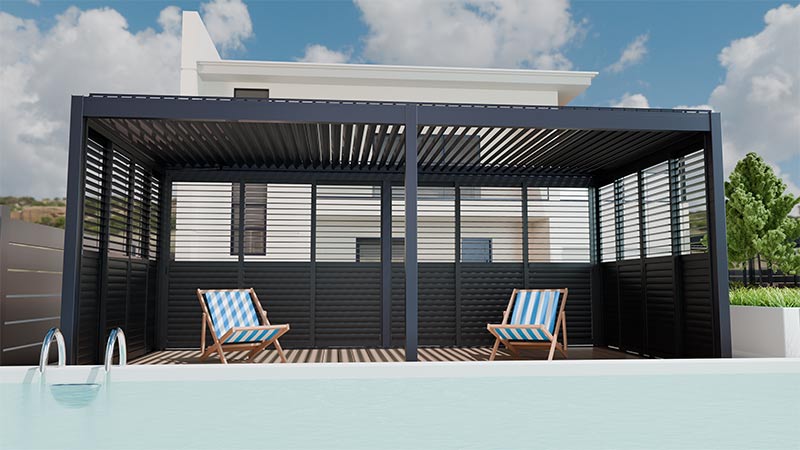
Professional planning must take into account orientation, building height, window positions and relative distances; when direct sightlines are unavoidable, installing targeted side screens, shutters or adjustable vertical sunshades can balance privacy with spatial openness.
For developers, this location-specific planning approach avoids over-design, creates private and aesthetically pleasing outdoor spaces, and enhances the perceived value and market appeal of properties.
3. How to Choose the Optimal Pergola Orientation
When to Choose North-South Orientation?
- For All-Day Thermal Balance: As the sun moves from east to west, north-south oriented louvers can capture or block light more evenly. When the sun reaches its highest point at noon, the blades can be fully closed for shading or slightly opened to achieve a chimney effect (for ventilation and cooling).
- For Abundant Morning Sunlight and Cool Afternoons: If you are located in the Northern Hemisphere, tilting the blades slightly eastward can introduce soft morning sunlight; as the sun moves westward, adjusting the blade angle can block the hot afternoon western sun.
- For Multi-Purpose Living Spaces: If the client intends to use the space from morning coffee to evening parties, north-south orientation provides the most stable light control.
When to Choose East-West Orientation?
- For Ultimate Energy Efficiency of “Warm in Winter and Cool in Summer”: In winter, the sun follows a low, southward trajectory. East-west oriented blades can be adjusted to an angle almost parallel to the sunlight, allowing warm winter sun to penetrate deeply into the interior (if the pergola is adjacent to floor-to-ceiling windows). In summer, the blade spacing can be used to block high-angle intense sunlight.
- For Specific Time-Period Usage Needs: If the client mainly uses the pergola at noon, east-west orientation provides extremely tight shading during midday.
- When Restricted by Building Structure: If the backyard is narrow and long or the pergola must be installed along an east-west wall, ideal results can still be achieved by adjusting the blade spacing and tilt angle.
Solutions for Complex Environments
- Managing low-angle glare in east–west orientations
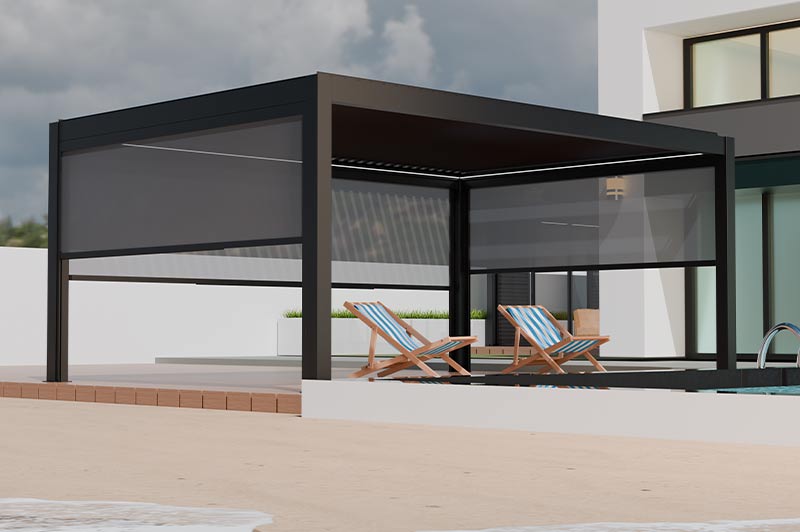
Pergolas facing east or west are exposed to low-angle sunlight in the morning and late afternoon, which cannot be effectively blocked by roof louvers alone. In these cases, motorized vertical side blinds are essential to control glare, reduce heat buildup, and maintain usable outdoor space. - Manual smart control through app and remote systems
Motorized louver systems are operated via app or remote control, allowing precise adjustment based on real-time weather and usage needs. This manual control approach offers reliable flexibility across seasons.
| Orientation | Core Advantage | Ideal Applications | Recommended Configuration |
|---|---|---|---|
| North–South | Balanced daylight, efficient natural ventilation | Main living areas, all-day cafés, hospitality terraces | Motorized louver system with app / remote control |
| East–West | Enhanced winter sunlight, stronger midday shading potential | Scenic rooms, winter-oriented spaces, lunch-time dining areas | Vertical blinds |
4. Why Can the Greenawn System Solve Location and Layout Challenges?
In most projects, orientation constraints are unavoidable. Plot boundaries, building layouts, and planning regulations often restrict the ideal installation location. In such cases, system performance matters more than orientation itself.
Motorized Louver System
The motorized louver system of Greenawn enables the pergola to adjust dynamically according to the sun’s position and temperature levels. Even with a fixed installation location, the adjustable louvers allow users to regulate light, airflow, and shading effects throughout the day .This flexibility can transform an originally suboptimal orientation into a fully functional outdoor space.
Smart Sensors
Integrated rain, wind speed, and temperature sensors further enhance product performance. The pergola can respond to weather changes from any direction—it closes automatically when it rains, adjusts louver angles in strong winds, and optimizes air circulation during high temperatures. This level of automation reduces risks, improves comfort, and delivers significant value to B2B clients.
5. Conclusion
With 29 years of experience, Greenawn is not just a pergola manufacturer—we are a provider of engineered outdoor systems. Orientation is one of many variables that define pergola performance, and addressing it requires more than guesswork or aesthetics.
By combining structural engineering, adaptive technology, and OEM/ODM capabilities, Greenawn helps partners deliver pergola solutions that perform reliably in real-world conditions. The result is not only a better outdoor experience but a more sustainable, scalable, and valuable product offering.
Aluminum Pergola Installation Cost in the USA 2025
blogWhat are the Benefits of a Pergola?
blogUltimate Aluminum Pergola Installation Guide for Outdoor Spaces
blog