
Pergola vs Trellis vs Arbor vs Gazebo: Engineering Comparison for Outdoor Structure Selection
December 13, 2025

Why Understanding the Differences Matters in Outdoor Projects
In outdoor projects, while a Pergola, Trellis, Arbor, and Gazebo are all decorative and shading framework structures, they have fundamental differences in technical specifications, functional objectives, and project feasibility.
For project professionals like us, understanding these distinctions is crucial for accurate judgment:
-
What level of safety and load capacity is truly required? (e.g., Can it support a heavy ceiling fan?)
-
Should we choose aluminum, steel, or wood to minimize maintenance costs?
-
Can the structure withstand wind and rain intrusion in the local climate?
-
Can it be perfectly integrated with accessories like lighting, drainage, and side screens?
-
Is the project truly feasible, and will the long-term maintenance costs be prohibitive?
-
Can it successfully pass local building codes, permits, and engineering acceptance?
Believe us, selecting the wrong structure can have severe consequences! Therefore, a precise technical comparison is absolutely indispensable before installation begins.
1. What Is a Pergola?
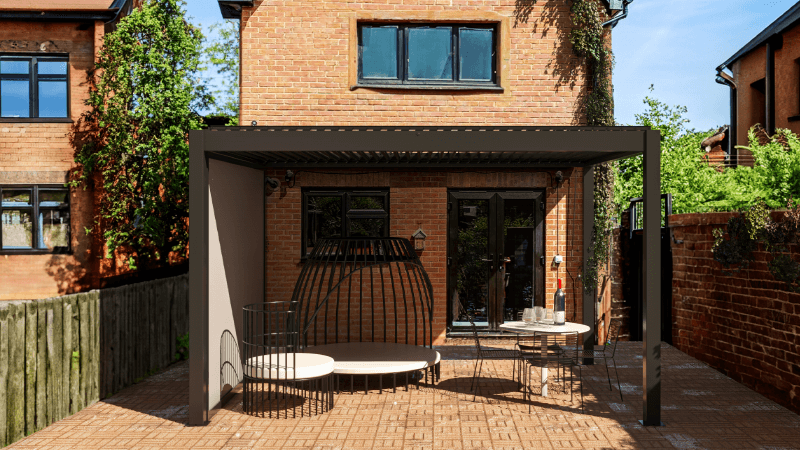
On an engineering level, a Pergola is a medium-to-heavy-duty outdoor structure. It composed of columns, load-bearing primary beams, and a rafter or louvered roof system, all of which are carefully designed to withstand structural loads.
The soul of the Pergola lies in its flexible roof system, which offers versatile climate control unmatched by a Gazebo. Options range from basic open slats and stable fixed aluminum panels to the most popular electric louvered roof—an option that provides all-weather sealed rain protection.
Regarding material selection, while steel and wood are available, our primary OEM/ODM focus is on aluminum alloy due to its superior corrosion resistance, lightweight nature, and longevity. This translates to the lowest maintenance costs for your customers, significantly boosting your competitive edge.
A Pergola’s engineering span typically covers 3–6 meters, but thanks to scientific load distribution and advanced OEM profile systems, our Pergola GR-9700A can extend up to 6–8 meters. This provides an unparalleled advantage for commercial projects aiming for large-area, column-free designs.
2. What Is a Trellis?
A Trellis is a lightweight, grid-like vertical support structure, made of intersecting slats, rods, or lattice framework, which can be freestanding or attached to walls or fences. Its core function is to provide climbing attachment points for vines and climbing plants, efficiently utilizing vertical space for gardening while optimizing ventilation and sun exposure—it is a classic decorative garden component.
It is crucial to note that the Trellis’s design limits its structural strength—it possesses absolutely no load-bearing capacity. It is only suitable for purely decorative gardening scenarios, cannot meet any functional needs for shade or rain protection, and must not be used in commercial projects requiring specific load specifications. It is fundamentally different from an engineering-grade Pergola in application and performance standards.
3. What Is an Arbor?
The name Arbor originates from the Latin word for “tree.” Its primary function is to serve as a transitional marker for entrances or pathways, often featuring an arched top, and it also offers support for climbing plants. However, the Arbor’s structural limitations are very clear; much like a Trellis, it is essentially a decorative element. Consequently, it is unsuitable for large spans, cannot bear heavy loads, and its resistance to wind and rain is very limited. It cannot meet the safety and functionality requirements of advanced engineering projects. If you are in B2B, it should not be a core component of your product line.
4. What Is a Gazebo?
Structural Comparison
This table should be presented directly to your engineering clients, offering the most intuitive performance comparison.
| Feature | Pergola | Trellis | Arbor | Gazebo |
| Structural Load | Medium–High | Negligible | Low | High |
| Primary Use | Functional Outdoor Living Space | Vertical Plant Support | Decorative Entrance | Complete Weather Shelter |
| Wind Performance | High (Engineering-grade certified louver system) | Very Low | Low | High |
| Span | Up to 6–8m with aluminum | <1m width | 1–2m | Fixed by geometric design |
| Roof Type | Open / Louvered / Retractable | Open Lattice | Open only | Solid roof |
| Material Durability | Aluminum best | Variable | Wood mainly | Wood/Steel/Aluminum |
Function Comparison
-
Pergola : Provides shade and ventilation, with the option for all-weather rain protection. The key selling point is the electric louvered roof’s all-weather control and integrated customization capabilities.
-
Arbor : Primarily a decorative structure. Offers no useful shade or weather protection.
-
Gazebo : Provides maximum weather protection due to its solid roof. Suitable for public spaces or gardens requiring a permanent, completely enclosed roof.
-
Trellis : Offers no effective shade or weather protection. Its sole function is to act as a growth support for climbing plants.
Cost & Lifecycle Comparison
- Material Costs: Arbor (Lowest) / Trellis (Extremely Low) < Pergola (Medium-High) < Gazebo (Highest).
- Installation Costs: Gazebo > Pergola > Arbor > Trellis.
- Maintenance: Aluminum alloy provides the lowest lifecycle maintenance costs. Wood structures (Arbor, some Trellis) require high maintenance.
- Lifespan: Aluminum Pergolas (20–30 years) > Steel Gazebo > Wood Gazebo / Arbor / Trellis (Generally the shortest).
Application Recommendation – Which One Should You Choose?
Pergola, Arbor, Trellis, or Gazebo?
Ultimately, every outdoor structure has its unique mission. Trellises handle vertical gardening, Arbors handle decoration, Gazebos handle extreme protection, and the Pergola is the most flexible system, best adapted to modern commercial needs. It perfectly balances structural strength, shade and weather control, modular design, and large-span engineering capability.
For the modern outdoor living projects we are undertaking—especially those utilizing advanced aluminum alloy systems—the Pergola offers the optimal combination of engineering performance, functional flexibility, and lifecycle value.
Whether you are planning a hotel project, developing a new outdoor solution, or expanding your OEM/ODM product line, understanding and articulating these differences to your clients will ensure you make better design decisions and secure greater long-term performance and commercial returns.
Are Louvered Pergolas Waterproof? A Complete Outdoor Guide
blogPergola Trends 2026: What Homeowners Are Choosing?
blogWhere to Put a Pergola for Maximum Enjoyment?
blog